Haddonfield Town Center Map Guide: Official Landmarks
Learn what the official reveal confirms about Haddonfield Town Center, its downtown landmarks, four-map launch context, and post-release route verification.
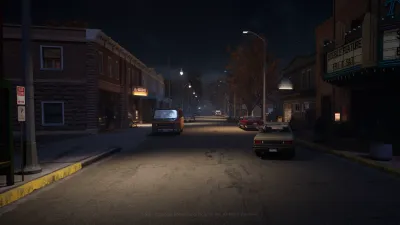
What is Haddonfield Town Center?
Haddonfield Town Center is the second official map reveal and the cultural and economic hub of Haddonfield. The official description presents it as a quaint Midwestern downtown shaped by local businesses, public services, family routines, and familiar film-world atmosphere. This page records those confirmed landmarks without turning the reveal into an unverified tactical map.
The official homepage frames Halloween: The Game as a 1v4 asymmetrical horror experience set in Haddonfield on Halloween night in 1978. The official map overview identifies four unique multiplayer maps for launch, including Haddonfield Town Center, Haddonfield Heights, Orange Grove Estates, and East Haddonfield. That context matters for search readers: Town Center is one launch map in a larger Haddonfield setting, not a published promise that every district connects through one continuous playable route.
The Town Center reveal emphasizes a sense of “Small Town America.” Its streets are described as cozy and historic, with businesses that have served residents for years. The tone is deliberately ordinary and welcoming, which gives the map its horror contrast. The official material does not provide an overhead layout, a scale, or a complete list of gameplay objectives, so the confirmed identity of the map is its setting and its named places.
Which landmarks are officially shown?
The official reveal names several destinations in Haddonfield Town Center. They should be read as environmental and narrative landmarks until post-release testing confirms any specific interaction or route function.
- Nichols Hardware is described as a small-town hardware store carrying equipment, tools, first aid kits, seasonal treats, and Halloween masks. The broader official map overview places Nichols Hardware in the heart of Town Center and says it is where Michael completes his transformation into the Boogeyman. Those details establish its story and visual importance; they do not establish an item-spawn table.
- Patty’s Pub is a local meeting place with pool tables, jukebox music, drinks, and a pay phone outside. The reveal says it is open until 2 AM daily, but that business-hours detail is part of the setting description, not a confirmed match timer or objective.
- A-Side Music Store is the town’s music shop, with records and musical instruments. It represents the everyday retail side of the district and helps distinguish Town Center from the residential and rural maps.
- Hill Garden Center sells landscaping equipment, trees, flowers, and garden decor. The official article also describes interactive outdoor landscaping that lets shoppers imagine how products might look in a yard. No specific gameplay interaction is confirmed by that description.
- The post office is presented as a full-service facility with a large mail room prepared for parcel volume. Margie’s Auto Repair services foreign and domestic vehicles and is described as a place that gets local cars back on the road. Haddonfield cemetery sits away from the busiest downtown streets, with laid-out paths leading visitors toward gravesites.
Together, these locations make Town Center readable as a functioning neighborhood rather than a collection of unnamed combat spaces. The reveal moves from shopping and entertainment to vehicle service, mail, and mourning. That range is useful for players looking for the Haddonfield Town Center map by landmark name, but it still does not answer where a particular item, exit, player, or objective appears in a match.
What theme does the reveal establish?
The map’s main theme is a lively downtown that feels safe, social, and economically active before the horror interrupts it. Local shops have loyal regulars, families and friends have built memories on the streets, and everyday errands give the neighborhood a strong sense of place. The cemetery and late-night atmosphere add unease without changing the official description into a route guide.
Art Director Cole Gray explains that the team used original film locations as an “ignition point” and extended outward to create a cohesive Midwest town. The same statement describes a balance between a sleepy rural aesthetic and intentional environmental storytelling. In practical reading terms, that means players can expect the official reveal to prioritize recognizable atmosphere and cinematic roleplay. It does not prove that any named business is a safe zone, a required stop, a fixed objective, or a superior position.
What remains unverified about the map?
As of September 4, 2026, the official pages used for this article do not publish the complete playable geometry of Haddonfield Town Center. They do not verify map dimensions, an overhead floor plan, exact entrances, fixed player spawn points, escape locations, item or weapon locations, objective order, shortcut connections, traversal times, or an optimal route. The official screenshots and reveal video are previews, not a substitute for repeatable in-game measurements.
The same caution applies to the named landmarks. A store being described as a source of equipment in the town’s fiction does not prove that a player can collect a particular item there. A pay phone being visible in the setting does not prove that it starts an interaction. The cemetery’s paths do not prove that they form a shortcut. Until those claims are tested in the released game, this page keeps them in the category of official environmental details.
How should you verify a route after launch?
Treat a route as a testable claim rather than a guess based on the reveal images. Record the platform, game version, date, match type, and the exact landmarks used as the beginning and end of the run. Capture the complete movement sequence so a reader can distinguish a confirmed connection from a path that only looked continuous in a screenshot.
Repeat the same test across multiple matches and note whether doors, obstacles, objectives, vehicles, or other conditions change. Separate fixed observations from match-dependent observations. If a route depends on an item or an escape interaction, record the exact interaction and its conditions instead of writing that the landmark always provides it. Only call a route “best” after a documented comparison against reasonable alternatives; otherwise, label it as one observed route.
This wiki will use the same evidence standard for the other launch maps. Compare the confirmed landmarks in Haddonfield Heights, Orange Grove Estates, and East Haddonfield before assuming that a visual motif or business type works the same way elsewhere.
How does Town Center fit the four-map launch?
The official launch overview lists these four maps: Haddonfield Town Center, Haddonfield Heights, Orange Grove Estates, and East Haddonfield. The homepage and map overview establish the broader Haddonfield setting and the multiplayer context. They do not state that players can walk from one map into another during a match, so this article does not infer a connected-world route.
The official Town Center reveal points to a September 8, 2026 launch. The verification date for this page is September 4, 2026, before that global launch date. Post-release updates should add only observations supported by recorded gameplay and should preserve the distinction between official pre-release descriptions and community-tested route data.
Sources
Evidence gallery
Related field reports
maps
East Haddonfield Map Guide: Official Landmarks
Learn what the official four-map overview confirms about East Haddonfield, including Rabbit in Red, Phelps Garage, farmland, and route-verification limits.
maps
Haddonfield Heights Map Guide: Official Landmarks
See what the official Haddonfield Heights flythrough confirms, including the Strode house, Myers house, Lampkin Lane, water tower, and launch-map context.
maps
Orange Grove Estates Map Guide: Official Landmarks
Review the official Orange Grove Estates reveal, including multi-story homes, the park, Wallace and Doyle residences, and what routes still need launch testing.
Was this report useful?
Response recorded